Wednesday, February 26, 2020

CAMEROON ARMY ACCUSED OF MASSACRE IN ANGLOPHONE REGION


Yaoundé, CAMEROON
Human Rights Watch on Tuesday accused Cameroon's armed forces of taking part in the killing of at least 21 civilians this month in a region where troops are battling anglophone separatists.

"Government forces and armed ethnic Fulani" carried out the slaughter in Ngarbuh, whose victims included 13 children and a pregnant woman, HRW said.
In its statement, HRW said: "Government forces and armed ethnic Fulani" carried out the slaughter in Ngarbuh, whose victims included 13 children and a pregnant woman.
The Fulani are an ethnic group also called Peuls.
"The gruesome killings of civilians, including children, are egregious crimes that should be effectively and independently investigated, and those responsible should be brought to justice," said Ilaria Allegrozzi, HRW's senior Africa researcher.
"Denying that these crimes have occurred adds another layer of trauma to survivors and will only embolden government troops to commit more atrocities."
The army says there were only five civilian deaths, which it said happened when fuel containers exploded in a firefight.
The incident occurred on February 14 in a remote part of the Northwest Region -- one of two English-speaking regions gripped by conflict sparked by demands for independence from majority French-speaking Cameroon.
In a separate development on Tuesday, Cameroon's constitutional council announced it had annulled the results legislative elections held on February 9 in parts of the two separatist regions.Image result for Watchdog HRW accuses army in massacre in anglophone Cameroon
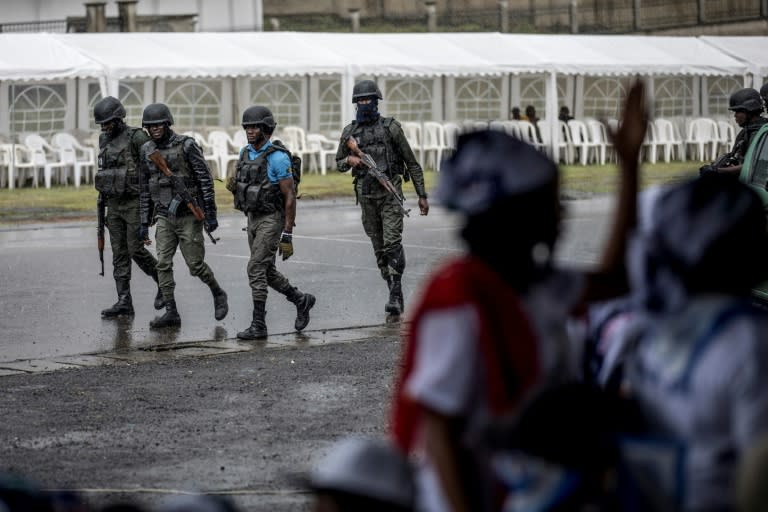
HRW on Tuesday said it drew its conclusions after interviewing 25 people, including three witnesses to killings and seven relatives of victims. It also reviewed satellite imagery taken before and after the attack.
Between 10 and 15 soldiers, including members of the elite Rapid Intervention Battalion, along with at least 30 armed Fulani, entered Ngarbuh, a district of the Ntumbo village, at around 11:00 pm (2200 GMT) on February 13, it said in a statement.
After hours of looting homes and beating civilians, some of these men attacked the so-called Ngarbuh 3 district, "killing 21 civilians in four homes, then burning the houses", it said.
The military told the residents "the attack was to punish civilians suspected of harbouring separatist fighters", HRW said, quoting 12 witnesses.
Opposition figures in Cameroon swiftly accused the armed forces of having played a role.
But on February 17, army spokesman Colonel Cyrille Atonfack Guemo said the deaths had resulted from an "unfortunate accident" when fuel was set ablaze during a gunfight between troops and separatists after a patrol came under heavy fire.
Five civilians -- a woman and four children -- had died, and "seven terrorists" were "neutralised," Atonfack told AFP.
The following day, the UN rights office in Geneva said 23 had died in the "shocking episode" and urged Cameroon to carry out an "independent, impartial and thorough" inquiry.
The violence came less than a week after the February 9 legislative election.
On Tuesday, Cameroon's constitutional council announced it was annulling that election in the South West region's Lebialem constituency and in 10 constituencies in the North West region.
The council said the elections would have to be rerun, state television reported.
The authorities have so far released no figures on either the election results or the turnout, but the African Union has said that turnout was low across the country, particularly in the two English-speaking regions.
English-speakers account for nearly a fifth of Cameroon's population of 24 million, who are majority French-speaking.
Years of grievances at perceived discrimination against English-speakers snowballed into a declaration of independence in the anglophone regions in October 2017, which was followed by a government crackdown.
The declaration has not been recognised internationally and President Paul Biya, in power for 37 of his 87 years, has refused demands to return to a federal system.
However, the government has lately decentralised some of its powers after a "national dialogue" on the anglophone crisis which was boycotted by the separatists.
More than 3,000 people have died and at least 700,000 have fled their homes in the nearly 29-month-old unrest. Rights monitors say abuses have been committed by both sides.

EGYPT TO BURY FORMER PRESIDENT MUBARAK IN MILITARY FUNERAL

Guards carry the coffin of former Egyptian President Hosni Mubarak as they arrive at Field Marshal Mohammed Hussein Tantawi Mosque, during his funeral east of Cairo, Egypt February 26, 2020.

CAIRO, Egypt
Egypt will on Wednesday bury its former president Hosni Mubarak, who died at the age of 91, in a military funeral in Cairo.
Mubarak ruled Egypt for 30 years until he was forced out of office by protests in 2011. He spent many of the subsequent years in jail and military hospitals before being freed in 2017.
He died on Tuesday in intensive care weeks after undergoing surgery.
Egypt’s presidency and armed forces mourned the former air force officer as a hero for his role in the 1973 Arab-Israeli war. The presidency declared three days of national mourning.
Egypt’s top military officials are expected to attend the funeral in an eastern suburb of Cairo, but it was not clear if President Abdel Fattah al-Sisi would do so.
Mubarak’s coffin will be air lifted from the mosque where the funeral will be held to the burial grounds, state television reported.

Mubarak was sentenced to life in prison for conspiring to murder 239 demonstrators during the 18-day revolt in 2011, but was freed in 2017 after being cleared of the charges.
He was convicted in 2015 along with his two sons of diverting public funds to upgrade family properties. They were sentenced to three years in jail.
Mubarak said history would judge him as a patriot who served his country selflessly, but for many Egyptians his time in power was a period of autocracy and crony capitalism.

CAF BARS ZIMBABWE FROM HOSTING INTERNATIONAL MATCHES


Cairo, EGYPT

Zimbabwe may have to find a ‘home’ away from home when they kick-off their World Cup qualifiers later in the year after being barred from hosting international matches by the Confederation of African Football (CAF).


The Zimbabwe Football Association (ZIFA) confirmed on Tuesday that all three of their main stadia – Barbourfields in Bulawayo, Mandava in Zvishavane and the National Sports Stadium in Harare – had failed inspection visits by CAF last November.

They are due to host Algeria in March in the Africa Cup of Nations qualifiers and finish that campaign at home to Zambia in September.

The World Cup qualifiers get under way in October, though the fixtures have yet to be released. Zimbabwe have been drawn in a pool with Ghana, South Africa and Ethiopia.

“Stadium authorities were notified of CAF’s position and the urgent nature of the situation at hand,” ZIFA said in a statement.

“To date, neither of the three stadium authorities has requested us to invite CAF for another inspection, a position which CAF has said led to the decision to bar all three stadiums from hosting international matches.”

ZIFA went on to plead for stakeholders including the government to provide funding to complete the work needed at the dilapidated venues.

“In this moment we urge all stakeholders to work for a common cause for us to quickly right this wrong which takes away our sovereignty.

“We have been using stadiums which do not meet CAF and FIFA standards for a while now, but we need to put our heads together as a country to ensure that our stadiums are renovated to meet required standards,” it said.

“We are hopeful that everyone who has influence to expedite the process of bringing our teams back home will do their part.”

ZIFA confirmed that it was exploring alternative venues in neighbouring countries.

Tuesday, February 25, 2020

EAST AFRICA’S HUGE LOCUST OUTBREAK SPREADS TO CONGO


Kampala, UGANDA
The United Nations Food and Agriculture Organization (FAO) says a small group of desert locusts has entered Congo, marking the first time the voracious insects have been seen in the Central African country since 1944.

The agency says the mature locusts, carried in part by the wind, arrived on the western shore of Lake Albert on Friday near the town of Bunia.
The worst locust outbreak that parts of East Africa have seen in 70 years also recently reached South Sudan, a country where roughly half the population already faces hunger after years of civil war.
Kenya, Somalia and Uganda also have been battling the locust swarms, which can reach the size of major cities.
The insects can destroy crops and devastate pasture for animals, and experts have warned that the outbreak is affecting millions of already vulnerable people across the region.
Uganda’s government said Tuesday it was trying to contain a large swarm and will need more resources to control the infestation that has spread to over 20 districts in the north. Soldiers have been battling swarms using hand-held spray pumps, while experts have said aerial spraying is the only effective control.
The U.N. recently raised its aid appeal from $76 million to $138 million, saying the need for more help is urgent. Experts have warned that the number of locusts if unchecked could grow 500 times by June, when drier weather is expected in the region.
A changing climate has contributed to this outbreak as a warming Indian Ocean means more powerful tropical cyclones hitting the region. A cyclone late last year in Somalia brought heavy rains that fed fresh vegetation to fuel the locusts that were carried in by the wind from the Arabian Peninsula.
A new generation of the locusts has been growing up in the Somalia desert in recent weeks, preparing to take flight as the next wave headed toward Kenya, Ethiopia and beyond. - Africa

PRESIDENT KENYATTA TAKES OVER MANAGEMENT OF NAIROBI CITY


By Collins Omulo, NAIROBI Kenya
The Kenya national government has taken over the running of Nairobi County amid uncertainty at City Hall.
President Uhuru Kenyatta and Senate Speaker Kenneth Lusaka witness as Nairobi Governor Mike Sonko and Devolution minister Eugene Wamalwa sign deal on February 25, 2020 at State House.
In what State House termed one of a kind landmark agreement, Governor of Nairobi, Mike Sonko on Tuesday handed over key functions of the county government to the national government pursuant to Article 187 of the Constitution.
The functions include county health services, transport services, county public works, utilities and ancillary services as well as county government planning and development.
“This will ensure Nairobi residents receive services efficiently. The move comes as a breakthrough in the running of county services that had ground to a halt,” said a statement from State House spokesperson Kanze Dena-Mararo.
The meeting was chaired by Devolution Cabinet Secretary Eugene Wamalwa, in concurrence with President Kenyatta.
There has been a crisis at City Hall after Sonko was barred from office by a court last year following his arrest over a Sh357 million graft case.
Ward Representatives have been up in arms over what they termed deterioration of services in the capital city.
The Members of County Assembly (MCAs) also decried dwindling revenue collection, poor state of roads in the city, poor waste management and lack of medicine in city hospitals.
The MCAs are planning to impeach Sonko. - Daily Nation

LESOTHO PM TO RESIGN IN JULY 2020

Maseru, LESOTHO
Lesotho Prime Minister, Thomas Thabane, on Tuesday lauded himself for "voluntarily" agreeing to resign after he was accused of having a hand in the 2017 murder of his estranged wife.
Lesotho Prime Minister Thomas Thabane.
The premier has bowed to pressure to step down and announced July 31 as his official resignation date, citing advanced age.
He appeared in court on Monday for allegedly acting in "common purpose" in the killing of 58-year-old Lipolelo Thabane, with whom he was in the process of divorcing.
The matter was deferred to the High Court, where he is expected to be formally charged on a date that has not yet been decided.
Thabane's All Basotho Convention (ABC) party has asked him to leave office "immediately" and nominated chairperson Sam Rapapa as his successor.
During an address to parliament on Tuesday, Thabane complained about the lack of praise for his decision to retire early.
"I had hoped that this parliament would set a record today of someone stepping down by cutting short their tenure," said Thabane, aged 80.
"Not many people would do that but I am doing it, and instead of being given a pat on the shoulder, I get insults," he added. "I don't understand you people."
Lipolelo Thabane's murder sent shockwaves through Lesotho - a tiny landlocked nation of 2.2 million with a history of political turmoil.
She was gunned down outside her home in the capital Maseru just two days before her husband took office.
The accusations against her husband came after communications records from the scene of the murder included Thabane's mobile phone number.
His current wife Maesaiah Thabane, 42, whom he married two months after Lipolelo's death, is considered a co-conspirator in the murder case.
She has already been charged with murder and is out on bail.
Thabane's defence lawyer has argued that his client should be granted immunity from prosecution for as long as he remained in office.
The prime minister has yet to comment on the accusations. He maintains that he decided to resign due to "old age".
"I am my grand-kids' grandfather," he told parliament. "Not yours."

MALAWI FRESH ELECTIONS SET FOR MAY 19, 2020

Lilongwe, MALAWI
Parliament Monday passed the Parliamentary and Presidential Elections Act (PPEA) Amendment Bill that effectively set May 19 2020 as the date for a fresh presidential election as ordered by the Constitutional Court on February 3.

Further to the amendment, driven by the verdict of a five-judge panel of the High Court of Malawi sitting as the Constitutional Court that nullified the May 2019 presidential election over irregularities, the term of office for members of Parliament (MPs) and ward councillors elected during the May 21 2019 Tripartite Elections has been extended from five to six years to ensure the concurrent holding of the two elections alongside the presidential election on May 21 2025.
The new PPEA (Amendment) Bill has also made a provision for a run-off or rerun within 30 days after the election in the case that no presidential candidate attains the 50 percent-plus-one vote in the first round of the vote. The run-off would be between the candidates with the highest and second highest number of votes.
The developments followed the tabling of amendments to two Electoral Reforms Bills on Monday by Lilongwe City South West MP Nancy Tembo (independent) as Private Members’ Bill (PMB) Number 5 of 2020 and PMB Number 4 of 2020 tabled by Nkhata Bay West legislator Chrispine Mphande (UTM Party).
Ironically, Parliament had on Thursday shot down the same provisions meant to facilitate the holding of fresh presidential election and setting dates for the same when they were presented as Constitutional Amendment Bill. The Bill by Chitipa East legislator Kezzie Msukwa (Malawi Congress Party-MCP) failed to garner the required two thirds majority vote for constitutional amendments.
The Constitutional Amendment Bill proposed to insert a new Section 80A.
When the House reconvened from a weekend recess yesterday, the proposed changes were moved to the PPEA and Electoral Commission Act (Amendment) Bill.Image result for malawi fresh elections
In an interview after the Bills sailed through, Tembo said she was happy that Parliament had finally set the dates for the elections and hoped the President will sign the Bills into law.
She said: “These Bills make further provision for the holding of the fresh presidential poll as directed by the court to be held on Tuesday in the third week of May 2020, that is, on 19th May this year.
“As a consequence, and in order to maintain the country’s five-year electoral cycle as provided under the Constitution, the Bill provides that the next general election, as prescribed under Section 67 (1) of the Constitution, shall be held on Tuesday in the third week of May 2025.”
In his reaction, Minister of Justice and Constitutional Affairs Bright Msaka welcomed the amendment and passing of the Bills, saying the legislators have protected the Constitution.
“This is not a constitutional amendment. That is what people should know. We have amended the Bills and that is a welcome development,” he said in an interview.
Before the House started tackling the amendments which Speaker of Parliament Catherine Gotani Hara said were brought on the floor following a decision by the Business Committee—a committee comprising leaders of respective parties that sets business to be tackled—Leader of the House Kondwani Nankhumwa said the government side was not represented in the said meeting.
He said: “We on the government side did not attend the Business Committee. I got notification today at 8am while I was in Mulanje.”
But Hara said Nankhumwa could have delegated representation, saying: “The Business Committee knew that the motions to be presented were important because of the court order whose 21 days deadline is today [Monday]. There were prior arrangements and you needed to delegate if you knew you were not going to be present, our own Standing Order 161(1) explains.”
Besides amending the Bills, the power of the President to appoint members of the Malawi Electoral Commission (MEC) will be exercised on the recommendation of the Public Appointments Committee of Parliament.
The five-judge panel comprising Healey Potani, Mike Tembo, Ivy Kamanga, Redson Kapindu and Dingiswayo Madise, which unanimously upheld the petition to nullify the election, also tasked Parliament to facilitate the reconstruction of MEC which the court found to have been “grossly incompetent”.
Commenting on Parliament’s decision, Garton Kamchedzera, professor of law at Chancellor College—a constituent college of the University of Malawi, said now the onus is on the President to do his part.
“It now rests on the President to assent to the Bills,” he said.
The Constitutional Court directed the House to pass Electoral Reforms Bills following the nullification of the May 21 2019 presidential elections in preparation of a fresh election in 150 days from the day of the ruling. - Africa

HOSNI MUBARAK: A LIFE IN PICTURES

Egyptian President Hosni Mubarak at an opening ceremony of a new Nile River canal in January 1997.
Former Egyptian strongman Hosni Mubarak, who died Tuesday aged 91, ruled his North African nation with an iron fist for 30 years until his 2011 ouster from power. At the height of his power, he was dubbed the Pharaoh, but he leaves behind a mixed legacy.
Undated picture of Hosni Mubarak as a young Royal Egyptian Air Force lieutenant, taken before the revolution that deposed King Farouk in 1952.
Undated picture of Hosni Mubarak as
a young Royal Egyptian Air Force
 lieutenant, taken before the revolution
that deposed King Farouk in 1952


Born on May 4, 1928 in Kafr-El Meselha in northern Egypt, Muhammad Hosni El Sayed Mubarak spent his childhood years in relative poverty. His prospects changed when he joined Egypt’s Military Academy, graduating in 1949. He switched to the Air Force in the 1950s and gradually rose up the military ranks.

Mubarak became a national figure as commander of the Egyptian Air Force and deputy defense minister, when he played a decisive role in planning a surprise attack in the early stages of the 1973 Yom Kippur War against Israel.

His reward came two years later, when then Egyptian president Anwar Sadat appointed him vice president.

On October 6, 1981, Mubarak was at Sadat’s side when Islamist Egyptian soldiers opposed to their country’s 1979 peace deal with Israel shot and killed the president during a military parade commemorating the 1973 war. 

Mubarak was wounded in the attack, but lived. He would survive several more attempts, including a dramatic one in 1995, when militants fired at his motorcade during a visit to the Ethiopian capital, Addis Ababa.
Hosni Moubarak, then vice president of Egypt, with then President Anwar Sadat, a few minutes before the attack that killed Sadat on October 6 1981.
Hosni Moubarak, then vice president of Egypt, with then President Anwar Sadat, a few minutes before the attack that killed Sadat on October 6 1981

Mubarak became president after Sadat's death, at a time when his populous, impoverished nation faced isolation following Egypt's ouster from the Arab League over the peace deal with Israel.
Mubarak started working his country's way back into the Arab world, by building a bilateral relationship with Iraq’s Saddam Hussein. The tactic yielded results: Cairo was Baghdad’s ally during the 1980-1988 Iran-Iraq War, and two years after it ended, Egypt was accepted back into the Arab League at the initiative of Iraq and Yemen.
Egyptian President Hosni Mubarak delivers an address at the Police Academy in Cairo on January 24, 1985.
Meanwhile the country’s draconian emergency law, which remained in place throughout Mubarak’s presidency, provided the backdrop for a security crackdown against the Islamist opposition, with brutal detention conditions in Egypt’s police stations and jails. Mubarak consistently defended his regime’s human rights track record, as he did in a 1985 speech at the Cairo Police Academy, pictured below.  

In Sadat's days, Mubarak was long considered a loyal deputy lacking in leadership and charisma. In a report in the French daily Le Monde, the journalist Hicham Kassem wrote that former US Secretary of State Henry Kissinger, who met Mubarak in the 1970s when he was vice president, thought he had a minor staff job “because he was so low-profile.”

But as a head of state and government, Mubarak proved to be adept at leveraging the US-Egyptian relationship, maintaining his country’s controversial peace treaty with Israel and earning considerable US military and economic aid in the process.

On September 28, 1995, Mubarak, along with Jordan’s King Hussein, joined then US president Bill Clinton at the White House when then Israeli prime minister Yitzhak Rabin and PLO chairman Yasser Arafat signed the Israeli-Palestinian Interim Agreement.


US President Bill Clinton watches Israeli Prime Minister Yitzhak Rabin and PLO Chairman Yasser Arafat sign a peace accord in the White House as Hosni Mubarak and King Hussein of Jordan look on in September 1995.
US President Bill Clinton watches Israeli Prime Minister Yitzhak Rabin and PLO Chairman Yasser Arafat sign a peace accord in the White House as Hosni Mubarak and King Hussein of Jordan look on in September 1995. 

But the deal did not bring peace, nor Palestinian liberation from Israeli occupation, and Mubarak was derided on the Arab street. Egypt’s peace deal with Israel, dependent on ties with the US, and Egyptian prison cells full of with tortured Islamist opposition figures earned Mubarak various monikers, including “America’s puppet” and “laughing cow” after the cheese brand.

French President Jacques Chirac and Mubarak on October 16, 2002, in Alexandria, Egypt.
While poverty, rampant corruption and human rights abuses were widespread at home, foreign policy dominated Mubarak's presidency, and abroad he was considered a pillar of the Arab political establishment.

By the mid-2000s however, under US pressure, Mubarak began to ease his grip on political life. Protests – and an independent and critical media – were largely tolerated.

In early 2005, Mubarak called on parliament to amend Article 76 of the constitution to allow other candidates to run in elections, scheduled for later that year. But when the September elections were finally held, restrictions on opposition candidates ensured that only Mubarak’s ruling party candidates won.


Campaign workers in Cairo add the finishing touches to a billboard ahead of the 2005 Egyptian elections.
Campaign workers in Cairo add the finishing touches to a billboard ahead of the 2005 Egyptian elections. 
Mubarak also won the presidential election, as he had when he stood unopposed in referendums in 1987, 1993, and 1999. Critics said the 2005 poll was neither free nor fair, and when it was over, Mubarak's principal opponent, Ayman Nour, was jailed.
Mubarak meets US President Barack Obama at the White House on September 1, 2010.
During his 30-year tenure, Mubarak worked with five US presidents, ending with Barack Obama, who was in office when protests against Mubarak’s rule erupted in Egypt.
Libyan leader Muammar Gaddafi rests his arms on the shoulders of Egyptian President Hosni Mubarak, right, and Yemeni President Ali Abdullah Saleh in October 2010. A few months later, all three leaders were removed from power.
In the winter of 2011, an extraordinary protest movement shook the Arab world. Following the ouster of Tunisian president Zine El Abidine Ben Ali, thousands of Egyptians took to the streets in Cairo, turning Tahrir Square into a protest camp and a symbol of the Arab Spring. The movement would see the overthrowing of Mubarak, Libya’s Muammar Gaddafi and Yemen’s Ali Abdullah Saleh. 
Protesters in Cairo's Tahrir Square hold up defaced posters of President Hosni Mubarak on January 30, 2011.
After decades of wooing foreign leaders, Mubarak was unable to win the love of his own people. Aging and frail, he anointed his son, Gamal Mubarak, as his de facto business-political successor, in a country where the state and military own major economic assets. The younger Mubarak was viewed as a corrupt upstart, sparking deep resentment.
The size and scale of the protests caught the Egyptian establishment by surprise.
Egyptian President Hosni Mubarak addresses the nation on February 1, 2011. His resignation announcement was deemed too little, too late.
Amid speculation that he would either run for a reelection later that year and then cede power to Gamal, the besieged "Pharaoh” delivered a televised address on February 1, 2011, announcing he would not stand for reelection. But it was not enough and too late. The crowds in Tahrir Square had expected the strongman to announce his resignation. On February 11, Mubarak accepted the inevitable and stepped down.
Hosni Mubarak, centre, with his sons Gamal, left, and Alaa, right at a court hearing April 13, 2013.
Hosni Mubarak, centre, with his sons Gamal, left, and Alaa, right at a court hearing April 13, 2013. 
Following his resignation, Mubarak and his son Gamal faced corruption charges. The former president also faced charges for ordering the killing of protesters. An ailing Mubarak attended the court proceedings on a hospital bed.
Hosni Mubarak at the trial of Mohamed Morsi on December 26, 2018.
Hosni Mubarak at the trial of Mohamed Morsi on December 26, 2018. 
Mubarak’s last public appearance was a dramatic face-off between two former Egyptian presidents, when he testified in a Cairo criminal court on December 26, 2018 at the trial of Mohamed Morsi, his successor and Egypt’s only democratically elected president, who died in custody on June 17, 2019. - France24

EGYPT'S FORMER PRESIDENT HOSNI MUBARAK DIES AT 91

CAIRO, Egypt

Hosni Mubarak, Egypt's president for almost 30 years who stepped down after a popular revolution in 2011, has died. He was 91.

Mubarak served as Egypt's fourth president starting in 1981 until his ouster in what became known as the Arab Spring revolution. 
He was jailed for years after the uprising, but was freed in 2017 after being acquitted of most charges. The acquittal stunned many Egyptians, thousands of whom poured into central Cairo to show their anger against the court.
The Arab Spring protests convulsed autocratic regimes across the Middle East.
State television reported on Tuesday that Mubarak died weeks after undergoing surgery. His brother-in-law, General Mounir Thabet, told AFP news agency he passed away at Cairo's Galaa military hospital.
Throughout his rule, he was a stalwart US ally, a bullwark against armed groups, and guardian of Egypt's peace with Israel.
But to the tens of thousands of young Egyptians who rallied for 18 days of unprecedented street protests in Cairo's central Tahrir Square and elsewhere in 2011, Mubarak was a relic, a latter-day pharaoh.
Mubarak was born in a rural village in the Nile Delta in 1928. He left behind a complicated legacy as his rule was partly characterised by corruption, police brutality, political repression, and entrenched economic problems.
The former president had long maintained his innocence and said history would judge him a patriot who served his country selflessly.
He joined the Egyptian air force in 1949, graduating as a pilot the following year. He rose through the ranks to become the commander-in-chief of the Egyptian air force in 1972.
Mubarak became a national hero the following year with reports that the Egyptian air force dealt a substantial blow to Israeli forces in Sinai during the Yom Kippur War. 
His harsh stance on security enabled him to maintain the peace treaty with Israel.
Under his rule, Egypt remained a key United States ally in the region - receiving $1.3bn a year in US military aid by 2011. 
Mubarak had been sentenced to life in prison in 2012 for conspiring to murder 239 demonstrators during the 18-day revolt.
An appeals court ordered a retrial and the case against Mubarak and his senior officials was dropped. He was finally acquitted in 2017.
He was however convicted in 2015 along with his two sons of diverting public funds and using the money to upgrade family properties. They were sentenced to three years in jail.
Since his arrest in April 2011, Mubarak spent the nearly six years in jail in hospitals. Following his release, he was taken to an apartment in Cairo's Heliopolis district.
Many Egyptians who lived through Mubarak's time in power view it as a period of autocracy and crony capitalism. His overthrow led to Egypt's first free election, which brought in president Mohamed Morsi.
Morsi lasted only a year in office after mass protests in 2013 led to his overthrow by then defence chief General Abdel Fattah el-Sisi, who is now president.
Mubarak-era figures, meanwhile, are gradually being cleared of charges, and laws limiting political freedoms have raised fears among activists that the old regime is back.
Mubarak is survived by his wife, Suzanne, and his sons, Gamal and Alaa. - AFP